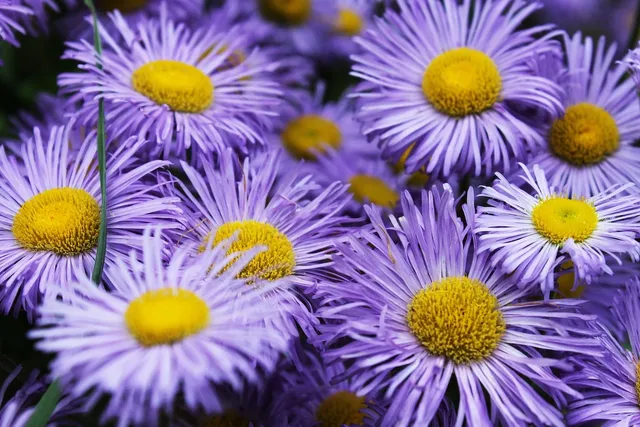


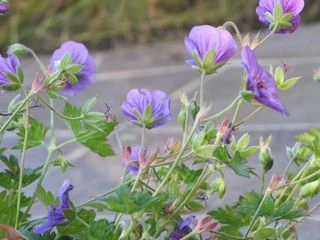
Yawn. Don't worry - I promise not to talk abour Geranium 'Rozanne' again.
When it came time to sign up for 2011 Garden Designer Roundtable topics, I initially passed on this month’s subject of top landscape plants. After all, posts about plants are pretty common around here, whether I’m rhapsodizing over peach-colored flowers, showing new alternatives to old favorites, or simply jawing on about my passion for fall foliage.
So instead of another post on some of my favorite plants, I’m giving you a peek behind the curtain and sharing recommendations from the folks I go to for inspiration – the Association of Professional Landscape Designers. While the speakers at our monthly East Bay district meetings are always entertaining and informative, my favorite part happens in the first 15 minutes, when members take turns highlighting a favorite plant that is then raffled off. I’ve chosen three to share with you today; one for its flower, one for texture and one for foliage color.
____
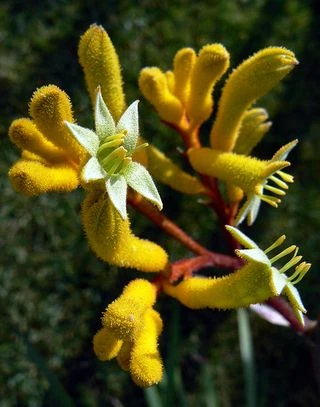
photo courtesy of
Anigozanthos manglesii ‘Kanga Yellow'
If you live in a mild climate, or like a touch of drama when choosing annuals for planting beds and containers, then you’re doubtless familiar with the architectural grace of Kangaroo Paw. What sets this charmer apart is its superior cold hardiness and its reputation for being one of the most prolific bloomers, sending up more flower spikes per plant than any other Anigozanthos. This is a moderately sized cultivar, with flower spikes in the 2-3’ range. A little online research revealed the Kanga series comes in additional colors, so if yellow is not your cup of tea, it may still be a great plant for you. I only learned about Kanga Yellow at last week’s meeting, so haven’t used it in a design yet, but I can picture this graceful beauty in contemporary, Mediterranean or tropical planting plans. USDA Zones 9a to 11 and cold hardy to 20 F, -6.6 C
____
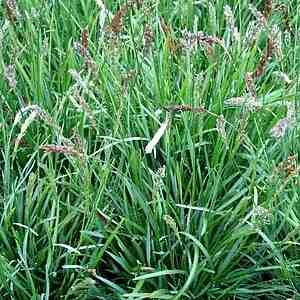
Photo courtesy of Native Sons Nursery
Sesleria ‘Greenlee’
I was the lucky winner when this grass was raffled off two years ago. I’m always on the look-out for a small scale, well behaved ornamental grass and Greenlee Moor Grass hasn’t disappointed me. Presumed to be a hybrid of S. caerulea and S. autumnalis, it was discovered growing in John Greenlee’s nursery in 2006. This evergreen, clumping blue-green grass grows 12” to 18” wide and thrives under a variety of conditions – I’ve moved it around a bit in my own garden and it’s done well in both a part-sun, moderate water zone and a full-sun, low water zone. Thick flowers with a rose-purple hue appear in the summer. For those of you jumping on the meadow-garden craze, Greenlee Moor Grass makes a solid choice. I could fit a sweet and reliable grass plant like this into just about any design, and use it to bring quiet contrast to plants with bolder foliage or flower color. Hardy to USDA zone 7 and cold hardy to 0 degrees F and -17 C.
___
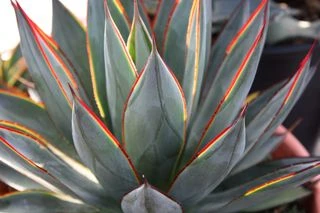
Photo Courtesy of Debra Lee Baldwin
Agave Blue Glow
I know I’m on the right track recommending Agave ‘Blue Glow’, as not only is it a top succulent choice for several APLD designers, but Debra Baldwin, noted author of Succulent Container Gardens: Design Eye-Catching Displays with 350 Easy-Care Plants , included it in a presentation at Gamble Gardens last month. Although I have succulents in my own garden and in some designs, I’m by no means an expert, so was thrilled to be able to nod knowingly in the audience when Debra praised this as one of her favorites. In fact, this is what Debra had to say when I asked for a photo: "It is indeed a gorgeous landscape plant, especially when positioned so it's backlit. The blue-gray leaves look brushed, as though painted with watercolors." Just try to resist that description.
Slow growing to 2’ to 3’, true blue, sweetly petite Blue Glow is the perfect choice for gardeners who avoid Agaves for fear of their massive size and thuggish reputation. Like many succulents, viewing up close reveals details that can be missed from a distance; in this case the subtle red and yellow margins. Nestle this elegant gem in a dark red pot and put it next to your favorite chair to be admired every day. Hardy to USDA zone 9a and cold hardy to 20 F, -6.6 C, but you can always overwinter in a sunny spot indoors.
In the mood for more plant recommendations? Check out what these Roundtable members have to say, in particular advice from our fabulous guest poster, Nancy Ondra, author of some of my favorite garden books including Grasses: Versatile Partners for Uncommon Garden Design and Fallscaping: Extending your Garden Season into Autumn.
Nancy Ondra, Hayfield, Bucks County PA
Andrew Keys, Garden Smackdown, Boston MA
Christina Salwitz, Personal Garden Coach, Renton WA
Genevieve Schmidt, North Coast Gardening, Arcata CA
Ivette Soler, The Germinatrix, Los Angeles CA
Jocelyn Chilvers, The Art Garden, Denver CO
Laura Schaub, Interleafings, San Jose CA
Lesley Hegarty & Rober Webber, Hegarty-Webber Project, Bristol, Avon, UK
Rebecca Sweet, Gossip in the Garden, Los Altos CA
Rochelle Greayer, Studio 'g', Boston MA