





When Rebecca and I first told friends and colleagues that we were writing a book on vertical gardening, a common misconception was that Garden Up!: Smart Vertical Gardening for Small and Large Spaces would be all about living walls. The reality is, we cover a range of ideas for gardening in vertical spaces and living walls make up only one chapter of the book. So why did I choose living walls as my subject for this month’s GDRT post on vertical gardening? Because creating my own has turned me into a serious fan. If you’re thinking about adding some living art to your own garden, here are my tips:
Choose the right framework
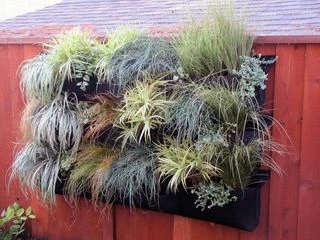
There are many living wall systems to choose from. Picking one appropriate for the plants you want to grow, your aesthetic vision and your willingness to perform maintenance are all important factors to consider. I choose to create a Woolly Pockets wall because they are easy to either hand-water or hook up to drip irrigation plus their deep pockets mean I can plant a greater range of plants and my design goal for this particular project was for a leafy, luxuriant look. Because the deep pockets mean it takes full or draping plants to hide or minimize the fabric framework, a wall made from a pocket system will generally look more lush and less minimalist. If you want to create a more contemporary piece of living art with cleaner lines and patterns, then a tray system might work better for you.
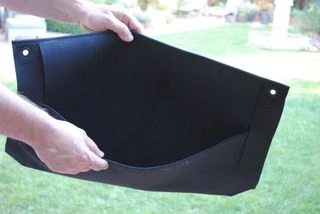
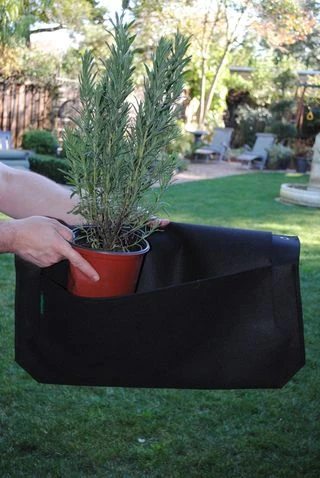
Roomy enough for one gallon plants, which helps to create an instant wall effect.
A system with deep pockets also means there’s room for some one gallon plants. Savvy gardeners know it’s better in the long run to plant smaller size containers, but a living wall has more in common with living art than with a traditional planting bed, and as such, I wanted the wall to look filled in as quickly as possible.
Pick plants thoughtfully

Choosing plants with Rebecca
When it comes to plants for living walls, without a doubt flashy, sassy succulents are the darlings of many living wall designers. I’m a fan myself, however, a succulent wall requires significant effort to design and plant, and generally can’t be hung right away, as the wall must lay flat for a period to allow the root system to develop. As a dedicated low maintenance gardener who does NOT favor prima donnas, I instead opted for choices that would be cold hardy and get by with a minimum of pampering – a mix of Carex and grass-like plants with a few trailers thrown in. Rebecca helped me design and plant the wall, and we spent a fun morning at Devil Mountain Wholesale Nursery in San Ramon California choosing from their huge selection of Carex and other plants.
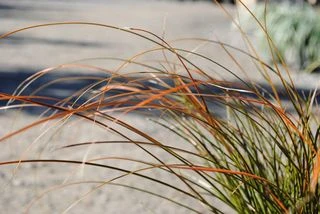
Orange-tinged Carex testacea for color contrast
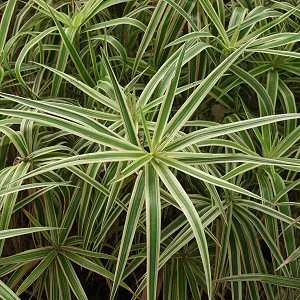
Carex phyllocephala 'Sparkler' for its brilliant foliage and upright form. Photo courtesy of Thyme after Thyme.

Liriope 'Silver Dragon' is one of the toughest shade plants around.
Location, location, location
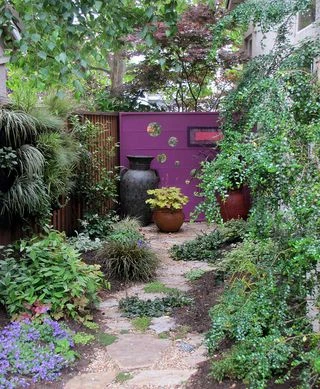
You might think such a prominent design feature as a living wall belongs front and center, but I took a different approach. My garden redesign two years ago included a complete overhaul of the side yard, but the vertical emphasis was the focal point wall at the end of the space. I favored perennials and small grasses to set off the meandering flagstone path, which didn’t leave much room for screening shrubs, and vines in a shady spot can be a challenge.
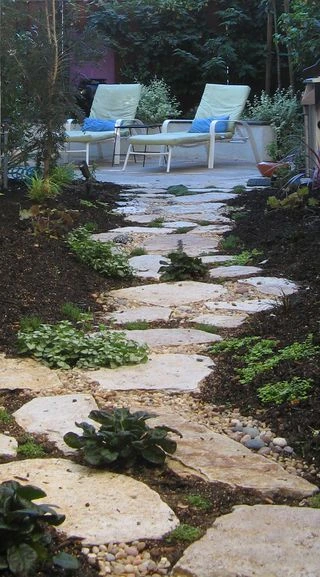
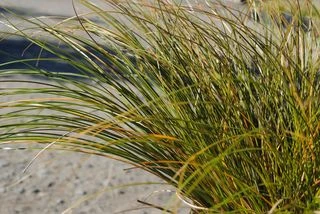
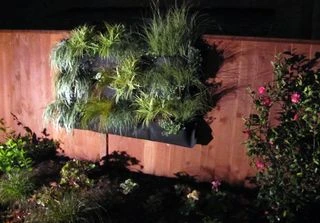
Because the side yard is a view corridor for the main seating area, and the fence is visible from the inside of the house, this was the perfect spot for a living carex wall. Another design consideration: putting a design emphasis on side yards, an often ignored portion of the garden, creates an element of discovery for visitors to the garden. With their odd combination of harsh mid-day sun bookended by deep shade and their tendency to funnel wind, it can be difficult to find appropriate plants for side yards. Easy-going Carexes are the perfect choice, and I love the way the breeze sets the wispy plumes of the Carex elegantissima dancing.
And how’s this for drama? The wall lit up at night. I may never close my curtains again.
Be sure to check out what these other roundtable members are saying on this topic:
Lesley Hegarty and Robert Webber, Hegerty Webber Partnership Bristol, Avon, UK
Pam Penick, Digging, Austin, TX
Rebecca Sweet, Gossip in the Garden, Los Altos, CA
Scott Hokunson, Blue Heron Landscapes, Granby, CT
Shirley Bovshow, Eden Makers, Los Angeles, CA
Tara Dillard, Vanishing Threshold, Atlanta, GA
All plant photos by Rebecca Sweet, including me in my cute pink cashmere scarf picking out grasses





Wonderful, Susan. I love your garden makeover, too.
(FYI, the Heggarty Webber link takes us to their Inspiration post, not Vertical Gardening... though I did find my way there by the scenic route)
Posted by: Helen at Toronto Gardens | March 22, 2011 at 10:36 AM
Love the first pic. Reminds me of Cousin Itt from The Addams Family !!
Hadn't thought of my Cousin Itt doll in decades.
Seriously, vertical gardening was the last thing I had to 'get' about landscape design.
Don't know why I was slow to understand, then epiphanies.
Many will be having them with your pics.
Gorgeous.
Garden & Be Well, XO Tara
Thanks, Tara. You have such a classic design sensibility, I'm not surprised vertical gardening isn't something you'd immediately gravitate towards since the first thing that comes to mind is a more modern interpretation. But there are lots of applications for traditional gardens as well.
Posted by: Tara Dillard | March 22, 2011 at 11:31 AM
Wow! I call that grassy pouch thing a real 'art installation'[, so textural and kinda spooky all lit up like that! Absolutely stonking!
Best
R
Robert, how perceptive. Stonking is exactly what I was going for!
Posted by: Robert Webber | March 22, 2011 at 12:03 PM
The "grass art" looks really cool, especially lit from below. What a great view for those admiring the garden from indoors!
I like that the pockets give one the opportunity to play with larger plants and make an instant hanging garden. I can't help wondering, though, how freeze-proof the plants would be, even tough ones like sedges. I can't imagine those pockets offer much insulation. Do you think freeze-prone climate gardeners should use annuals? Inquiring minds want to know more. :-)
Good point, Pam. Check out Stephanie Bartron's comment. she works for Woolly Pockets and it looks like they're going to provide more info on that topic.
Posted by: Pam/Digging | March 22, 2011 at 01:13 PM
Love it! Susan, I've been very intrigued by the living wall trend and trying to understand the very things that you have explained so well here: product, plants and placement. Thanks to you, I'm one step closer to finding the best solutions for mile-high Denver!
Thank you Jocelyn. As the concept moves from trendy to mainstream, I think there will be more and more options and information available to make it easier for designers and gardeners alike.
Posted by: jocelyn/the art garden | March 22, 2011 at 03:47 PM
I have loved the Carex filled pockets you and Rebecca created since I saw the video. I'm like Pam, wondering if I could keep the plants alive? Might just have to give it a shot this year!
Hi Shelia! Mine are overwintering easily, but I'm in a more mild climate and my wall is in a somewhat protected space. Colder climates would need to be more cautious.
Posted by: Sheila Schultz | March 22, 2011 at 05:19 PM
Susan, I'm with Robert - 'Absolutely stonking!' (of course I'm assuming that's a good thing). I love your choice of plants for the wooley pocket. You've inspired me to propose a few grass pockets to a new client to hide her garden shed. Thanks.
Debbie, I love it that you're getting a little vertical inspiration from this post! That's my favorite part of GDRT - seeing what other designers are up to always gives me new things to think about with my own clients.
Posted by: Debbie/GardenofPossibilities | March 22, 2011 at 05:20 PM
I've had Wooly Pocket's on my radar for a while now. I just haven't found the right project...maybe this year! Love how you did yours.
Thank you Susan. I have to admit I became a convert after doing my own. I'd love to see what kind of a design spin you put on living wall.
Posted by: Susan aka Miss R | March 23, 2011 at 04:11 AM
I agree, great job creating the Wooly Pockets wall, a great textural addition to the garden. As a plus it bring smaller grasses and grass-like plants up to eye level. Your garden is so inviting!
Congrats on the book, Diving into it this week. Can't wait!
Thanks, Scott! Can't wait to hear your feedback!
Unless it's bad. Then I can wait.
Posted by: Scott Hokunson | March 23, 2011 at 05:56 AM
Susan, that's a super beautiful woolly planting!
Can't wait to get the book!
I wanted to respond to the question about plants overwintering in Pockets. It's an issue because plants are less protected than in the ground, so you want to think about "root hardiness" not just plant hardiness. There are definitely some that can make it, and we should have a list on the Woolly Pocket website soon.
Stephanie, that question has come up before and my assumption is that anything will be less hardy with less earth around it, whether that's a pocket or the a container. But I was impressed by the fact that our friend Patrick Fitzgerald in Ireland successfully overwintered carex in much harsher conditions than I experience, although he planted in a tray system rather than woolly pockets.
Thanks for sharing Susan!
Posted by: Stephanie Bartron | March 23, 2011 at 12:47 PM
The planting with grasses looks like a perfect informal complement for the building with the almost barn-red siding. It shows really nicely how you can adapt the vertical walls to all sorts of garden styles.
Thanks James! One of our goals in the book is to show that vertical gardening is more than just living walls - and that even within the category of living walls, there are a lot of different design approach.
Posted by: lostlandscape (James) | March 24, 2011 at 10:12 AM
It's the movement that I'd really appreciate, movement at eye level.
Exactly!
Posted by: Rob (OurFrenchGarden) | March 27, 2011 at 01:48 PM
Thanks for giving very useful tips about adding some living art to our own garden, a wall made from a pocket system will generally look lush and less minimalist. If we want to create a more contemporary piece of living art with cleaner lines and patterns, then a tray system might work better for us.
Posted by: landscape contractors | April 06, 2011 at 09:06 PM
Lovely garden design ideas especially love the wall box!
Posted by: p3chandan | April 19, 2011 at 10:34 AM