

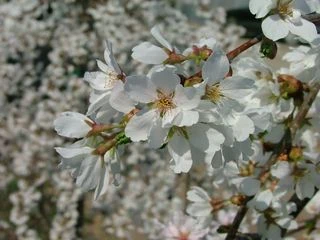
Snow Fountains 'Weeping Cherry'
all images courtesy of Maria Zampini
Just as there’s more than one way to skin a cat (I’m taking this on faith, of course, as I prefer my kitties fully-furred), there’s more than one way to fit a beloved plant into a small space. In Garden Up! Smart Vertical Gardening For Small and Large Spaces, Rebecca and I describe many strategies for working in small, tight spaces: choosing vertical plants; layering up, not out; and using your walls, fences or arbors as another place to garden. A classic way to achieve the last example is through the practice of espalier.
Espalier is the age-old garden custom of training trees and shrubs to grow flat onto a wall or fence. It is most commonly done with fruiting trees like apples or pears, but thanks to Maria Zampini, garden writer and president of UpShoot LLC in Madison, Ohio, I’ve learned it is also a wonderful way to show off the beauty of weeping ornamental fruit trees in smaller gardens.
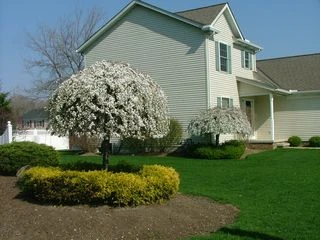
While I love their glorious early-spring blooms, the traditional mushroom shape that Snow Fountains Weeping Cherries are often trimmed into has generally left me cold – too reminiscent of a four-year-old boy’s head with a bowl cut. But Maria is passionate about the versatility of this classic plant, explaining that it can be used a dozen different ways in the landscape. “Unstaked, it acts as a ground cover, or can be planted to cascade over a wall. Let the limbs lie on the hot pavement – they can take it,” says Maria. “It is also superb as an espalier along a building fence or trellis.”
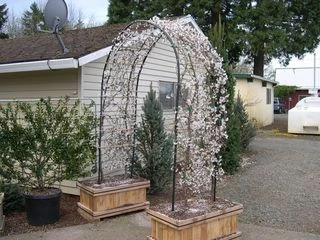
Snow Fountain trained on an arbor
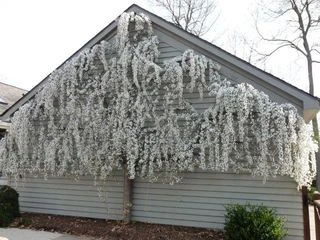
As an espalier trained to follow the lines of the house, courtesy of Brian Decker of Decker's Nursery in Ohio
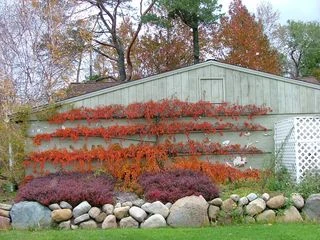
Blazing with fall color
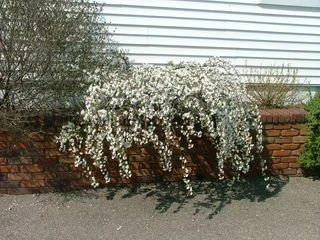
Cascading over a wall
Maria’s has also experimented with training weeping crabapples, and is particularly fond of Malus ‘Molazam' Molten Lava, a cultivar introduced to the trade by her father Jim Zampini. Grafted or otherwise, this is a terrific choice to add multi-season interest to a small space, as delicate white blooms are followed by tiny red fruit and lovely display of yellow fall color.
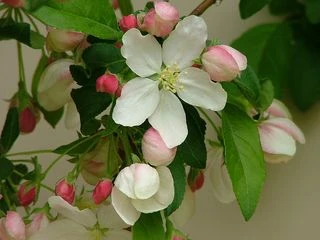
Spring
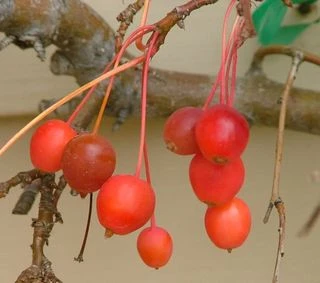
Summer
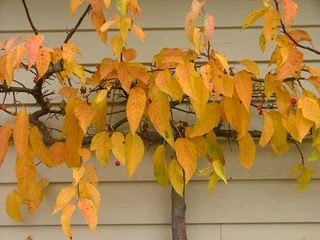
Fall
Maria and her family have introduced other high-performing ornamental fruit tree cultivars suitable for espalier or other small-space landscape uses, including her personal favorite, Malus Weeping Candied Apple. To learn more about their selections, available at nurseries nationwide, visit Lake Country Nursery.
Thank you, Maria, for sharing your lovely photos, and encouraging me to revisit a garden staple with fresh eyes.










We have a Prunus serrulata 'Snow Fountain' that is freestanding but trained in serpentine form and it is stunning. We're not usually seduced by flowers but this one, with so much else going for it, easily won a spot in the garden.
I'd love to see a picture, Sara! This really is a great multi-season tree. In my mild climate, it's only out of bloom for a few months of the year.
Posted by: Sara Malone | January 19, 2012 at 03:07 PM
Stunning examples...I rarely like the countless, poorly-placed weeping Blue Atlas Cedar here. Those you show are much more appealing - they actually relate to their spaces!
Thanks David! Maria has a knack for seeing traditional plants in new ways.
Posted by: Desert Dweller / David C. | January 19, 2012 at 05:37 PM
I'm coming up with some garden design ideas and thinking of plants to grow. Any suggestions for a cold climate?
Jenny, the weeping ornamental fruit trees mentioned in the post are hardy to USDA Zone 4.
Posted by: Jenny | January 20, 2012 at 08:47 AM
These photos are stunning! I'm thinking we need to write another book all about unusual espalier? Susan? Susan? Hello?
How about this? You write a book about unusual espalier and I will mention it in a blog post for sure!!
Posted by: rebecca sweet | January 22, 2012 at 08:03 AM