

And probably grab a table and order a round of drinks. But the question is, why are they hanging out together in the first place? It turns out they have more in common than you might think.
In their August issue, Psychology Today reports on the exotic field of neuroaesthetics, which is seeking to determine why we respond to art the way that we do. According to the article, art makes use of certain visual tricks that engage our brains in a variety of specific ways. So what we describe vaguely as beauty or creativity can in part be explained by how our brains process visual information.
The article shares 10 perceptual principles of great art, but I’ll just touch on a few.
The Peak Shift Effect occurs because our brain responds more eagerly to exaggerations and distortions than to real world people and objects. Why? Because this helps us recognize things, thereby hyper-stimulating our senses. A Picasso that exaggerates distinctive elements is attractive to us in part because it makes it easier for us to recognize what it is.

Picasso's self portrait may appeal because it makes it easier to recognize him.
And isn’t that the essence of a garden? A garden is not a replica of the natural environment, but instead is an intentionally artificial construct that exaggerates many of the elements we enjoy in nature. It may take its cues from the natural world, but its more orderly form and visually distinct spaces are exactly what makes it pleasing to us.
The Peekaboo Principle plays upon the fact that we enjoy a visual mystery and often respond to art that lets us fill in some of the blanks for ourselves. (The same principle applies to erotica, but that’s a post for another type of blog.) An artistic example of this is Cezanne's paintings of Mont Sainte-Victoire, where the mountain is implied, but it is up to us to fill in the missing space.
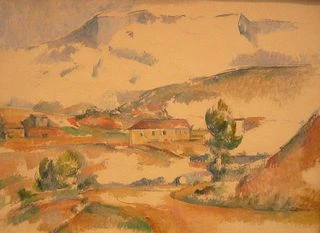
Garden designers employ this same principle when they reveal part of a view, or create the sense that something interesting is happening just around the corner, creating a little puzzle that engages us more deeply in the space. In my designs, I like to give the impression that a garden exists beyond its actual borders. A simple means of accomplishing this is to extend the backyard a few feet around the edge of the house, encouraging the eye to believe there is more to be discovered, even if the reality is a utilitarian concrete slab home to to compost bins and garden rakes.
So if some of you are thinking all you need to do now is find out what the other eight principles are and Presto! you’re a great artist, or if like me your first thought was whether two years of design school was educational overkill, it’s probably a bit more complicated. By hooking up subjects to MRI machines and testing their response to great art vs. kitch, neuroscientists are currently conducting experiments to determine if our brains can perceive a difference between great art and schlock.
In the meantime, I’m getting back to my current design and focusing heavily on principle number eight, Repetition, Rhythm and Orderliness with a little Grouping and Generic Perspective thrown in for good measure.






Drink orders
Artist: Bellini
Neurosurgeon: Mind Eraser
Garden designer: Garden Jubilee
Fascinating post, Susan!
And for Daffodil Planter? A nice cup of compost tea?
Posted by: DaffodilPlanter | July 14, 2009 at 12:54 PM
(hehe DP love the drink orders!)
Susan, what a great post! My latent Art History Major got all into it. Love how you tied it to the garden, and all so true. My training in 'seeing' art has given me much more than I realized at the time!
Oh, and make mine a 'Red Umbrella'
I can turn just about any experience into a metaphor for garden design. Not sure if this makes me insightful, or just self-obsessed.
Posted by: Laura Livengood Schaub (InterLeafer) | July 14, 2009 at 01:31 PM
Very deep, Susan! Understanding beauty or great art is an intriguing task. I have plenty of opinions (like some 'modern art' is a farce and the artists sit around laughing about the fools who pay them big bucks for it), but I enjoy having them challenged and modified by exposure to other creative individuals.
You could be right about your take on modern art. After all, what does it say about our gullibility that we're willing to pay a thousand times as much for water, just because it comes in a bottle?
Posted by: VW | July 14, 2009 at 04:27 PM
Oh man, I just eat this kind of thing right up! Love it! Absorbing, interesting post, Susan. I'll need to read it again a few times and really think about this...
There are so many psychological aspects wound up in the art of garden design. I always look for a way to create a serene seating environment where the client feels protected behind their body, with an interesting view before them. Back to the cave. Makes us feel secure.
Very inspiring post!
The tenth principle the article lists is metaphor. Maybe that is what you are tapping into with your cave analogy?
Posted by: Plantanista | July 14, 2009 at 08:34 PM
Susan, It's an interesting way to systematize aspects of design. The idea of suggesting much more than you actually see is a neat one to think about. I think a lot of Japanese gardening, for instance, uses that idea a lot. But I do wish they'd come up with a term for it other than "Peekaboo Principle!"
Good observation on Japanese gardening. I used Peekaboo Principle because it amused me, but the more high brow term is Perceptual Problem Solving.
Posted by: lostlandscape | July 14, 2009 at 09:26 PM
This really was interesting. I've always wished I could be an artist, maybe gardening is my attempt at it :)
I think I like the "Peekaboo Principle" because my yard is small, anything to make it appear larger is a plus.
Loved the post title!
Based on the photos you show of your charming garden on your blog, I definitely think you can call yourself an artist!
Posted by: Catherine/gardenerprogress | July 15, 2009 at 11:14 AM
Love the post, Susan!
I work with contemporary artists all the time (my husband is an art theorist - pretentious, I know, but he's cute!) and our language is very similar - it is a real joy to work with people who push you to go further into the more esoteric aspects of this business!
I love the interface that you are describing - I find that ALL creative disciplines use the same techniques, just employed in different ways using slightly shifting language.
Thanks for taking us to school today! I love it!
I agree with you on the overlap of creativity. The same principles and techniques I use when designing are the ones I respond when viewing others' creative works: whimsy, balance & surprise, just to name a few. Your hubby's profession sounds interesting, I don't even know what an art theorist is!
Posted by: Germi | July 15, 2009 at 05:30 PM
And just as with art, you either love something or you really don't. I don't really like Picasso, but adore van Gough. I don't really like certain gardens. Versailles comes to mind, but I didn't like Monet's garden either, too fussy and too rectangular. That's probably why good garden designers are also like therapists, and why you read Psychology Today...
I read Psychology Today because I find the interworkings of people very interesting, but as this post shows I have a seemingly unlimited ability to turn anything I come across into a metaphor for garden design. Versailles is actually a good example of one of the 10 principles - symmetry - but in my opinion while I consider it a great learning experience, its scale is such that it's hard for a plant loving gardener to relate to; it seems like a completely different animal. Kind of like calling Taco Bell Mexican food. It's not Mexican food, it's Taco Bell food!
Posted by: Town Mouse | July 15, 2009 at 08:03 PM
What a great post! Thought-provoking in so many ways. I've actually been thinking lately about my response to beauty: however I define it, beauty's been a major motivating factor through my life. (When asked why he became a gardener, Graham Thomas said simply, "A love of beauty.")
I'd be interested to ready up on how we distinguish art from kitsch - if we do. But I feel sure we do. I bet plants have no confusion on that issue, and they probably aren't guilty when they enjoy schlock, either. (What would plant schlock be?)
Well, Town Mouse would probably call impatiens and petunias plant schlock! I hope there is a follow up on what the experiments show as well, but I'm not sure we're going to get the answer we want. After all, if people really appreciated great art, how have poker playing dogs and velvet Elvis's managed to sell so well for all these years?
Posted by: Pomona Belvedere | July 15, 2009 at 11:13 PM
I would also be curious as to how these elements inform our preferences for individual plants within a landscape. Often when a person falls in love with a plant it is not because of its context within a garden or landscape but because our "neuroaesthetic" sense perceives that one plant as a successful and beautiful composition in its own right. Maybe the next time I am about to impulse-purchase a plant I don't need at the nursery I'll just run through the 10 elements real quick to make sure my brain is absolutely convinced of its aesthetic qualities.
Getting a mental picture of you at the local garden center armed with your plant list, credit card and 10 Perceptual Principles of Great Art cheat sheet.
Maybe we respond to the individual plant because of the principles of Balance and Isolation, but once we bring it into the garden, it also has to pass the tests of Grouping and Contrast.
Actually, a cheat sheet's starting to sound like a good idea.
Posted by: Maranta | July 16, 2009 at 08:13 AM
Hi Susan
one of the more interesting posts on the web right now.
I often think that garden designers have it tough in that they have to account for time. Not time to complete the project but time in how it grows, beds in, succession etc in seasons to come.
I'd hang that Picasso self portrait (is it yours?) on my wall ahead of say a photo of him as it's interesting, like an interpretation of a natural landscape or theme. Not sure that it would be because it is recognizable.
Psychology today eh. Well, as you say, there's a psychology to everything.
You are absolutely right about the time a garden takes to grow in - it's a lot of information to hold in your head. On the other hand, I know I can only take so much into account, and hope clients understand that even the best designed garden will need changing and editing over the years.
No the Picasso's not mine, I stole if off the internet so if it suddenly disappears, you'll know I was caught. I agree I'd chose it over a photo because it is more interesting, but here's the question: Unbeknowst to us, is our brain really just digging the ease at which it unraveled the distorted features and what we describe as interesting is really just our way of explaining this hardwired response to ourselves?
Posted by: Rob(ourfrenchgarden) | July 16, 2009 at 12:00 PM
hmmm, if they are willing to hire me, I would spend my days being judgemental... art here, trash there. Then they can see if the MRI's match my taste.
Well who doesn't want to get paid to pop off with opinions all day? If you figure out how to get a gig like that, let me know.
Posted by: wayne stratz | July 17, 2009 at 09:27 AM
Isn't it amazing how much we as garden designers can learn from, and also how much we have in common with, other disciplines and vocations... interesting post!
Hi Ross! I think this particular cord really struck a cord with some of my fellow designers. I received a few private emails on this one as well. Fun stuff to think about.
Posted by: Ross | July 28, 2009 at 06:10 AM
How easy is to make up an story to make it interesting. It is a shame that today's press does not care at all about the truth of a matter. All it matters is to make an story interesting to sell products. It takes at least 2o years of school to become a neurosurgeon and many other years to build a credible reputation for a pathetic lie like this to appear without the proper scrutiny. The press is reckless and useless.
Posted by: Best neurosurgeon | March 02, 2010 at 01:48 AM
Hmm. What's your problem, BN? Feeling a little defensive about your credentials?
I thought this was an interesting and thoughtful post. And I especially appreciate the elements of good design that you offer at the end.
I'm curious about the use of the MRI to determine "good" art from schlock; mostly I'd like to know if the brain's response changes to one or the other changes after discussion about a piece. I know that all those years of art history as an undergrad changed my own responses to particular works of art (made me appreciate them more instead of dismissing them out of hand)...
Thanks for the fun post!
Posted by: Susan Tomlinson | March 02, 2010 at 10:36 AM