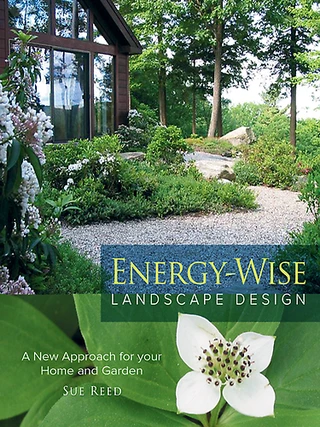
If you read my blog regularly, you know I rarely do book reviews (although that doesn’t mean you shouldn’t review my book when it’s out in three weeks). When I was given a copy of Sue Reed’s Energy-Wise Landscape Design: A New Approach for Your Home and Garden, however, I couldn't resist the chance to dig into a book I’d heard so much about.
An excerpt from the introduction says it all: This book shows how we can all save energy, simply by making small changes in the way we design and build our landscapes. Reed includes strategies for conserving both operating energy (the energy used in our day to day functioning such as fuel for lawnmowers) and embedded energy (the energy used to manufacture and transport equipment and services, such as the cost to manufacture concrete). During my Bay Friendly Qualified Design Professional training last year, for the first time I truly grasped the shocking cost of transporting potable water into a home, the majority of which gets flushed down a toilet or poured into the landscape, so I was pleased to see the inclusion of embedded energy, as it something most of us don’t even consider.
The first part of the book focuses on design, the second section explains how to build and care for landscapes in an energy-efficient manner and the third and fourth sections cover ideas for generating energy and lighting strategies. Information is presented in a way that is neither preachy nor condescending and the tone througout is friendly and non-judgmental.
Some information presented here was a more in-depth review of things I already knew (for example, that trees cool down a garden not only by providing shade but through the process of transpiration), but even then, the level of detail provided helped me understand the concepts much more thoroughly. By far the most useful portion to me are the early chapters focused on landscape design. This book goes well beyond traditional advice such as placing deciduous trees at the Southwest corner of the home. It provides suggestions on what to plant (and what not to plant) for all sides of a home, the pros and cons of different hardscape options and strategies for keeping the ground cool. Here in California, we’re more interested in fending off the heat than in capturing the sun in winter, but Reed does a good job outlining some of the trade-offs you make between heating and cooling your home if you live in a climate with more extreme weather variations. Detailed information on how the sun's angle of incidence affects temperature at different points in the day, the amount of shade cast by plants and options for creating windbreaks are all included.
If you’re a garden designer, Energy-Wise Landscape Design is a must have for your bookshelf. Not only will it improve your ability to design sustainable landscapes, but many of the chapters clearly express concepts I’ve struggled to communicate to my clients. This book will help me better explain how a sustainable design approach benefits both a homeowner and the environment.
Likewise, serious gardeners will appreciate the many practical tips, including Reed’s realization that most of us are not going to redesign our gardens from scratch. As such, she offers numerous tips for working with less than ideal existing site conditions.
One caveat: this is a hardcore book with very few pictures, and those are in black and white. Although Reed attempts to demystify the principles of energy-wise landscaping, many of the concepts are complex. For me, the book felt more like an entertaining text book (similar to Residential Landscape Architecture) than a garden book I would pick up purely for entertainment and inspiration.
If you’re serious about living a more sustainable, energy-efficient lifestyle, you can’t go wrong with Energy-Wise Landscape Design. To learn more, visit the book's website.